Sign Up
School Account Sign Up

Lesson ID: 11340
Learn to convert metric units with ease using a silly sentence and a smart chart—no calculator needed!




The Strange Tale of a Very Organized King
Meet King Henry. He wasn’t famous for battles or treasure, but for how he kept his kingdom perfectly measured!
He wanted everything—his castle halls, water barrels, and bakery flour—to be measured just right. So, he created a clever way to help his people remember how to convert between metric units.

Thanks to his legacy, we now have an easy way to jump between big and small units of measurement with just a chart and a few decimal moves.
It’s time to unlock the royal secret of metric conversions!
Learn to Convert Metric Units Like a Pro
The Magic of Metric Prefixes
In the metric system, all units are based on powers of 10. That means you can easily convert between different units by moving the decimal point left or right—no tricky math needed.
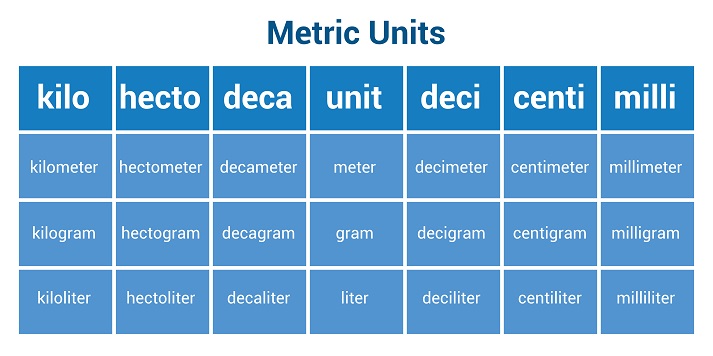
To do this, you need to know prefixes, which tell you how big or small a unit is compared to the base unit (meter, liter, or gram).
| Prefix | What It Means | Example Unit |
| kilo- | 1,000 times bigger | kilometer (km) |
| hecto- | 100 times bigger | hectogram (hg) |
| deka- | 10 times bigger | dekaliter (daL) |
| BASE | meter, liter, or gram | m, L, g |
| deci- | 1/10 the size | decimeter (dm) |
| centi- | 1/100 the size | centimeter (cm) |
| milli- | 1/1,000 the size | milliliter (mL) |
Each prefix stays the same whether you're measuring length (meters), volume (liters), or mass (grams).
Meet the Mnemonic: King Henry Died By Drinking Chocolate Milk
This silly sentence will help you remember the order of metric prefixes.
Each word in the sentence stands for a “step” on the conversion chart.

How to Use the Chart to Convert
Say you want to convert 3,000 milliliters (mL) into liters (L).
Start at milliliters in the chart.
Move left to liters, the base unit.
Count the number of steps: milli → centi → deci → base = 3 steps to the left.
Move the decimal point 3 places to the left: 3,000 mL = 3.0 L
Another example: Convert 1.4 liters to milliliters.
Start at liters (base) and move to milliliters.
Count: base → deci → centi → milli = 3 steps to the right.
Move the decimal 3 places to the right: 1.4 L = 1,400 mL
No calculator needed—just chart it and shift it!
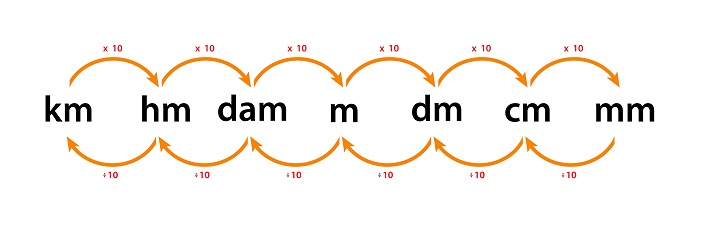
Abbreviations to Know
kilometer = km
hectometer = hm
dekameter = dam
meter = m
decimeter = dm
centimeter = cm
millimeter = mm
Same goes for grams (g) and liters (L)—just change the prefix, and you’re set!
Metric Units for Every Situation
Meters measure length. (How far is the park?)
Liters measure volume. (How much water is in a jug?)
Grams measure mass. (How heavy is the apple?)
And by using King Henry’s system, you can convert between any of these without confusion.
What’s Next?
Now that you’ve met the royal crew of metric prefixes and learned how to use them, it’s time to practice converting like King Henry’s most trusted advisor!
Try it out in the Got It? section!

Supplies
Additional Resources


 FAVORITE
 Like
Like